
Telangana Chief Minister K Chandrasekhar Rao announced Rs 10,000 as immediate relief to each flood-hit household in Hyderabad, lashed by incessant rains since last week, besides an assistance of Rs 1 lakh each to those whose houses were completely destroyed and Rs 50,000 for the partially damaged.

The two western states, already battling a raging pandemic, which has put their health infrastructure under severe strain, opened new fronts to tackle the fallout of the storm which is expected to make a landfall close to Mumbai on Wednesday. They are likely to be impacted most by the cyclone.

Isolated heavy rainfall is also very likely over north Konkan region during the same period, it said.

Chief Minister K Palaniswami announced a solatium of Rs 4 lakh to the kin of each of the victims

Five people, including a toddler, have been killed and over 100,000 people evacuated in Malaysia after one of the country's worst floods hit 4 states, forcing Prime Minister Najib Razak to cut short his holiday in the US.

Pakistan Meteorological Department's earthquake centre said the 5.8-magnitude earthquake was located near the mountainous city of Jehlum in Punjab province.

The sky turned cloudy around 4:30pm and gusty winds swept the national capital.

Five persons were killed on Tuesday in two separate incidents of landslips triggered by incessant rains in Meghalaya's West Garo Hills district.

The government has asked the general public to call toll free numbers 1070 and 1077 during emergency situations .

The Indian Meteorological Department, meanwhile, warned of intense spell of 30 to 50 mm rainfall per hour with strong winds in Mumbai and suburban areas.

He said India has a rich tradition and a long history of both discovery and use of science and technology.

'It affects our economy, it is very important in many ways.' 'So we have to be the foremost experts in the world on the monsoon.' 'But the best minds in India have not devoted their time to the study of monsoon and they have followed the fashions of the West.'

Pollution levels in Delhi and satellite towns shot up again on Sunday morning, with the air quality bordering the 'severe plus' category at several places.

About 4.41 lakh rural habitations are facing drinking water scarcity and the government is closely monitoring the drought situation on a daily basis in 10 states, Agriculture Minister Radha Mohan Singh said on Saturday.

Air quality in the national capital deteriorated alarmingly a day after Diwali as pollution levels spiked more than five times higher than normal leaving many at the risk of respiratory problems.
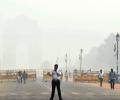
The overall AQI deteriorated further and touched the 268 mark, which falls in the poor category.

According to the SRC, the evacuation of eight lakh people is the largest-ever evacuation operation in the country.

Swarms of immature pink locusts and adult yellow locusts are currrently active. Not only are fresh locusts swarms expected to arrive in the coming weeks, but even those already present in India have mated and are breeding new offspring.

Pollution levels were inching towards 'severe plus emergency' category due to a change in wind direction and rampant stubble burning in neighbouring states

The cyclone on Tuesday passed the Mumbai coast and much to the relief of the people in Maharashtra's capital, just brought rains and there was no loss of life or damage to property

No immediate relief appears in sight as the India Meteorological Department issued a red alert for six districts which have been already pounded by downpour, forecasting "extremely heavy" rainfall and recommending preventive actions.

According to the System of Air Quality and Weather Forecasting and Research, the overall air quality of the national capital docked at 376 at 8:30 am on Tuesday.

The cyclone lay about 720 km east northeast of Chennai over the Bay on Monday and it is very likely to move west southwestwards and intensify further into a severe cyclonic storm by Tuesday.

He said all necessary medical help should be given to the injured, including treatment in India, if required.

Vegetable, fruit prices to be on the rise over weak supply, crop damage
Heavy to very heavy rainfall was expected over north Coastal Tamil Nadu and Puducherry in the next 24 hours.

Gale-force winds, heavy rainfall and high tidal waves swept the coastal belt of Kerala, Karnataka and Goa as Cyclone Tauktae hurtled northwards towards Gujarat on Sunday, leaving four people dead in Karnataka and two in Goa, damaging hundreds of houses, uprooting electricity poles and trees and forcing evacuation.

Slight tremors of 3.1 magnitude were felt in the national capital region on Monday night. The slight-intensity quake occurred at 12:41 am and the epicentre was Delhi, an India Meteorological Department report said.

The cyclone would bring light to moderate rains at most places and 'heavy to very heavy downpour' at some places on November 6.

According to SAFAR, both stubble burning in surrounding states of Delhi and firecrackers are causing deterioration of air quality in the national capital.

It is believed that the crop residue burning in the nearby states of Punjab and Haryana are contributing to polluting the air.

The Child Protection Services programme under the Integrated Child Development Services was increased to Rs 1,500 crore from Rs 925 crore.

Yield loss due to natural calamity is calculated based on field reports and assessment of crop-cutting experiments by district and block agriculture officers.

The PM2.5 level (presence in the air of particles with a diametre of less than 2.5 micrometres) touched a new high at 158 as authorities predicted further deterioration of air quality in the coming days.
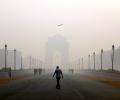
The problem is so severe that multiple agencies have issued several precautionary measures.

Large swathes of the country reeled under heatwave conditions on Tuesday with Churu in Rajasthan recording a high of 48 degree Celsius.

Authorities alerted people to avoid staying outdoors and L-G ordered to halt all civil construction activities across the city till Sunday.

While incessant rain in the past 24 hours has wreaked havoc in parts of the northeast, triggering flash floods, the national capital experienced one of its hottest days.

India and France on Friday signed 17 agreements, including on the stalled nuclear project in Jaitapur in Maharashtra, after Prime Minister Narendra Modi held wide-ranging talks with French President Francois Hollande.

The record temperatures in May were accompanied by other extreme events, including very heavy precipitation in parts of Europe and the southern US, and widespread and severe coral reef bleaching.
